
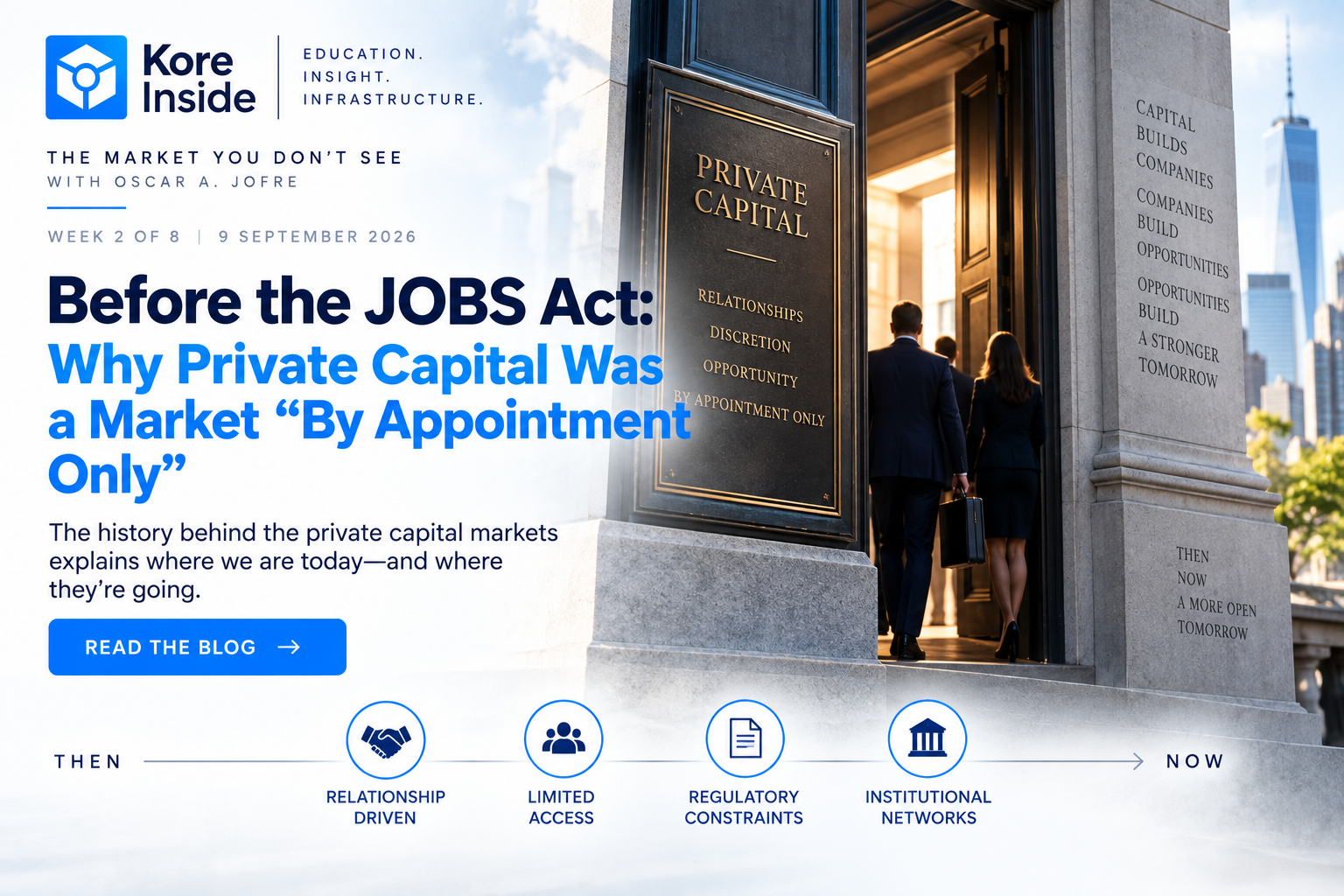
Last week, I began this series by discussing something I believe every investor should understand: the private capital markets are not a small alternative sitting on the sidelines of the financial system. They are an important part of how companies, funds and entrepreneurs obtain capital.
Yet they remain poorly understood by many individual investors and providers who have been support the private capital markets..
To understand why, we need to go back to how the market developed.
The private capital markets we have today did not suddenly appear with crowdfunding, online investment platforms or the JOBS Act. They are the result of decades of securities regulation, financial-market development and relationships between companies, investors and regulated intermediaries.
That history matters.
It explains why access to private investments was historically concentrated among certain investors and institutions. It explains why relationships became so important. It explains the role of the accredited investor. It explains why companies could not simply advertise many private offerings to the public.
Most importantly, it helps explain why the changes that began in 2012 were so significant.
It Starts With the Securities Act of 1933
Any serious discussion about American capital formation needs to begin with the Securities Act of 1933.
The fundamental principle remains with us today: every offer and sale of securities must either be registered under the Securities Act or qualify for an available exemption from registration.
That distinction created two very different pathways for capital formation.
There is the registered public market most investors recognize.
A company seeking to conduct a registered public offering goes through the SEC registration process and provides extensive disclosures. Public companies operate within a highly developed ecosystem involving exchanges, broker-dealers, clearing organizations, transfer agents, custodians, market data, research and numerous other participants.
Then there is exempt capital formation.
Congress and the SEC recognized that requiring every company raising capital to conduct a full registered public offering would not be practical.
Different exemptions therefore developed that allowed securities to be offered and sold without going through the traditional registered offering process, provided the requirements of the applicable exemption were satisfied.
That distinction is important because people sometimes hear the words “private offering” and incorrectly interpret them as meaning unregulated.
That is not how the market works.
Private and exempt offerings operate within securities laws.
The regulatory pathway is simply different.
Why Relationships Became So Important
Now consider this environment before today's internet-driven capital markets.
A private company needs $5 million.
- It is not conducting an IPO.
- It is relying upon an exemption from registration.
- Where does it find investors?
- Today, our first instinct might be to say:
- Put the opportunity online.
- Advertise it.
- Promote it through social media.
- Run digital marketing.
- Reach investors across the country.
But for many private offerings, historically, that simply was not permitted.
Even today, Rule 506(b), one of the principal exemptions under RegD, prohibits general solicitation and general advertising. The SEC identifies unrestricted public websites, advertisements and certain seminars among communications that may constitute general solicitation.
This helps explain one of the defining characteristics of the traditional private market:
Relationships mattered.
- A company might have relationships with existing investors.
- An investment banker might have relationships with investors.
- A broker-dealer might maintain investor relationships.
- Securities attorneys could be part of networks surrounding issuers and capital providers.
- Private equity and venture capital firms developed their own networks.
- Family offices built networks.
- Wealth managers built relationships with clients.
- Entrepreneurs developed relationships with other entrepreneurs and investors.
- The market functioned.
- Capital was raised.
- Companies were financed.
But it was not a market where every investor could simply open a screen and browse everything available.
This is what I mean when I describe the traditional private capital markets as:
By Appointment Only
I do not use that phrase to suggest there was some deliberate effort to hide the market.
The structure was a consequence of the regulatory framework and the way capital formation evolved within it.
If an issuer could not broadly advertise a particular offering, relationships naturally became part of distribution.
If investors needed to satisfy certain eligibility requirements, financial professionals and established networks became important.
If technology did not yet provide today's digital identity, compliance, payments and communications infrastructure, transactions depended heavily upon people and institutions.
That environment created a private-market ecosystem that was very different from the public markets.
The Accredited Investor Became an Important Part of That Ecosystem
Another concept anyone trying to understand private markets needs to know is the accredited investor.
The idea is central to significant portions of exempt capital formation.
The accredited-investor definition identifies individuals and entities that satisfy specified financial or professional criteria.
Why does that matter?
Because different exemptions can treat accredited and non-accredited investors differently.
Rule 506(b), for example, permits an unlimited amount of capital to be raised and prohibits general solicitation. Securities may be sold to an unlimited number of accredited investors and, subject to additional requirements, no more than 35 non-accredited investors during the applicable period.
Rule 506(c), which came later, changed an important part of that equation.
It allows general solicitation, but all purchasers must be accredited investors and the issuer must take reasonable steps to verify that status.
Notice what happened.
The market did not simply go from:
closed → open.
It became more nuanced.
Different regulatory pathways created different methods of reaching investors and different obligations for issuers.
That is why understanding the regulation matters.
The Internet Created a Problem the Old Framework Had Not Been Designed Around
By the late 1990s and 2000s, something fundamental had changed.
The internet transformed communication.
- It transformed commerce.
- It transformed banking.
- It transformed advertising.
- It transformed how people discovered products and services.
- Eventually, social media transformed communications again.
Information that previously traveled through relatively closed networks could suddenly reach millions of people.
That technological change created an obvious question for capital formation:
If companies can use the internet to reach customers around the world, why can't they use it to reach potential investors?
The answer was complicated because securities are not ordinary consumer products.
- Investor protection matters.
- Disclosure matters.
- Fraud prevention matters.
- Who can participate can matter.
- How an investment is promoted can matter.
The financial condition and sophistication of an investor can matter under certain exemptions.
Technology had changed the mechanism of communication.
Securities regulation still needed to determine how those mechanisms could be used appropriately for capital formation.
This tension between access and investor protection is important because it continues today.
I do not believe the future of private capital markets is about removing regulation so that everyone can do anything.
I believe the future is about creating better infrastructure that allows companies, investors and regulated intermediaries to operate efficiently within the regulatory framework.
Those are very different objectives.
Then Came the Financial Crisis
The 2008 financial crisis created enormous economic consequences.
Access to capital became a major concern, particularly for smaller and emerging companies.
Policymakers increasingly considered how regulatory changes could support entrepreneurship, job creation and capital formation while maintaining investor protections.
Out of that broader environment came legislation that would significantly affect the direction of American private capital formation.
On April 5, 2012, President Barack Obama signed the Jumpstart Our Business Startups Act, better known as the JOBS Act.
The significance of the JOBS Act is often reduced to the word crowdfunding.
I think that misses the bigger picture.
The JOBS Act addressed multiple areas of capital formation. Among its provisions, Title II addressed access to capital and general solicitation, while Title III created the statutory foundation for securities crowdfunding.
Implementation would occur over time through SEC rulemaking.
This was not one switch being turned on April 5, 2012.
It was the beginning of a structural change.
Rule 506(c): A Fundamental Change in Distribution
One of the most significant changes came through Rule 506(c).
For the first time under this pathway, an issuer could broadly solicit and generally advertise a RegD offering.
That meant the internet could play a fundamentally different role.
An issuer could potentially communicate an offering publicly rather than depending entirely on pre-existing relationships.
But there was an important condition.
All purchasers must be accredited investors, and the issuer must take reasonable steps to verify their accredited status.
That is an excellent example of how capital-market regulation evolves.
Access expanded.
Investor-protection requirements remained.
And a new infrastructure requirement appeared.
If accredited status now needed to be verified under Rule 506(c), technology and service providers needed processes capable of supporting that verification.
This is a pattern we will see repeatedly.
Regulatory change creates opportunity, but it also creates infrastructure requirements.
Crowdfunding Changed the Conversation Again
Title III of the JOBS Act established the statutory foundation that eventually became RegCF.
The SEC adopted the implementing rules in 2015, and eligible companies were able to begin using RegCF in May 2016.
Today, eligible companies can raise up to $5 million in a 12-month period under RegCF.
The transaction must occur online through an SEC-registered intermediary, either a broker-dealer or funding portal.
Think about the significance.
The private capital markets were moving from a world dominated by personal networks and private introductions toward a market where technology itself could become part of the regulated capital-formation process.
- The intermediary did not disappear.
- It became part of the digital infrastructure.
- That is an important distinction.
RegA+ Added Another Pathway
The JOBS Act also directed expansion of Regulation A.
The resulting framework created what is commonly called RegA+, with Tier 1 permitting eligible offerings up to $20 million and Tier 2 up to $75 million during a 12-month period.
RegA is particularly interesting because it sits differently within the capital-formation landscape.
It is an exemption from registration, but the SEC itself notes that these offerings share many characteristics with registered offerings. Tier 2 also includes audited financial statements and ongoing reporting requirements.
Again, this illustrates why describing everything simply as "private" can be misleading.
The exempt market contains multiple regulatory pathways with different characteristics.
- RegD is not RegCF.
- RegCF is not RegA+.
- And RegA+ is not an IPO.
Understanding these differences is part of becoming an informed participant in private capital markets.
What Actually Changed?
From my perspective, the biggest change was not simply that new regulations appeared.
The relationship between capital formation and technology fundamentally changed.
Before this evolution, distribution was heavily constrained by the mechanisms available and, depending on the exemption, restrictions on solicitation.
After the JOBS Act and subsequent SEC rulemaking, digital infrastructure could increasingly become part of how securities were marketed, investors were onboarded and transactions were completed under appropriate exemptions.
- That created opportunities.
- It also exposed weaknesses.
- Companies could reach more investors.
- But how would those investors establish their identities?
- How would KYC and AML be performed?
- How would investor eligibility be determined?
- How would accredited status be verified where required?
- How would payments move?
- Who would maintain ownership records?
- How would thousands of shareholders be communicated with?
- What would happen when investors wanted to transfer securities?
- How would regulated intermediaries interact with all of these systems?
These questions are the beginning of the next stage of the story.
My View
The JOBS Act was enormously important, but I do not believe its long-term significance should be measured only by the number of crowdfunding platforms created or the amount raised under one particular exemption.
Its greater significance was helping establish the conditions for capital formation to become increasingly digital.
That is the transformation I believe we are still working through.
The first challenge was access.
How do we allow companies to reach investors through new mechanisms while preserving appropriate investor protections?
We made significant progress on that question.
The second challenge is infrastructure.
How do we support a market where investors may participate across multiple offerings, issuers, intermediaries and platforms?
How do we establish identity once and use it appropriately across a regulated ecosystem?
How do we connect compliance?
How do we connect payments?
How do we maintain accurate ownership?
How do we support regulated transfers?
How do we improve data?
How do we create appropriate secondary-market infrastructure?
How do broker-dealers, funding portals, transfer agents, banks, custodians and other regulated participants work together?
This is why I believe we need to stop thinking about private-market technology exclusively in terms of individual platforms.
A platform solves a particular problem. Infrastructure connects the market.
The public markets learned this over decades.
Private capital markets are now going through their own evolution.
The JOBS Act helped open the doors.
The next question is what we build behind them.
Let's Continue This Conversation Live
There is only so much that can be covered in an article, and I believe investors benefit from hearing different perspectives.
That is why on Wednesday, September 23, 2026 at 1:30 PM ET, I will be hosting:
THE MARKET YOU DON'T SEE:
Where Capital Really Moves
This will be a live educational discussion about the private capital markets.
I am inviting 3–4 speakers representing different perspectives from across the ecosystem, with only one participant from KoreInside.
That is intentional.
This is not intended to be a KoreInside product presentation or investment pitch.
I want to bring together people who have spent their careers thinking about capital formation, securities regulation, investing and market infrastructure.
We will discuss how private markets developed, what changed following the JOBS Act, the differences among RegD, RegCF and RegA+, why investors participate, the risks investors need to understand, and where private capital markets may be heading.
Most importantly, attendees will have an opportunity to ask questions.
[RESERVE YOUR SEAT FOR SEPTEMBER 23 CLICK HERE→]
Next Week
Next week, we move from history into transformation.
We'll look at what happened as the doors began opening and private capital formation increasingly moved online.
Because the JOBS Act did something very important.
It helped change who could see the door and how companies could reach them.
But opening a door and building a functioning market are two different things.
That is where our story goes next.