
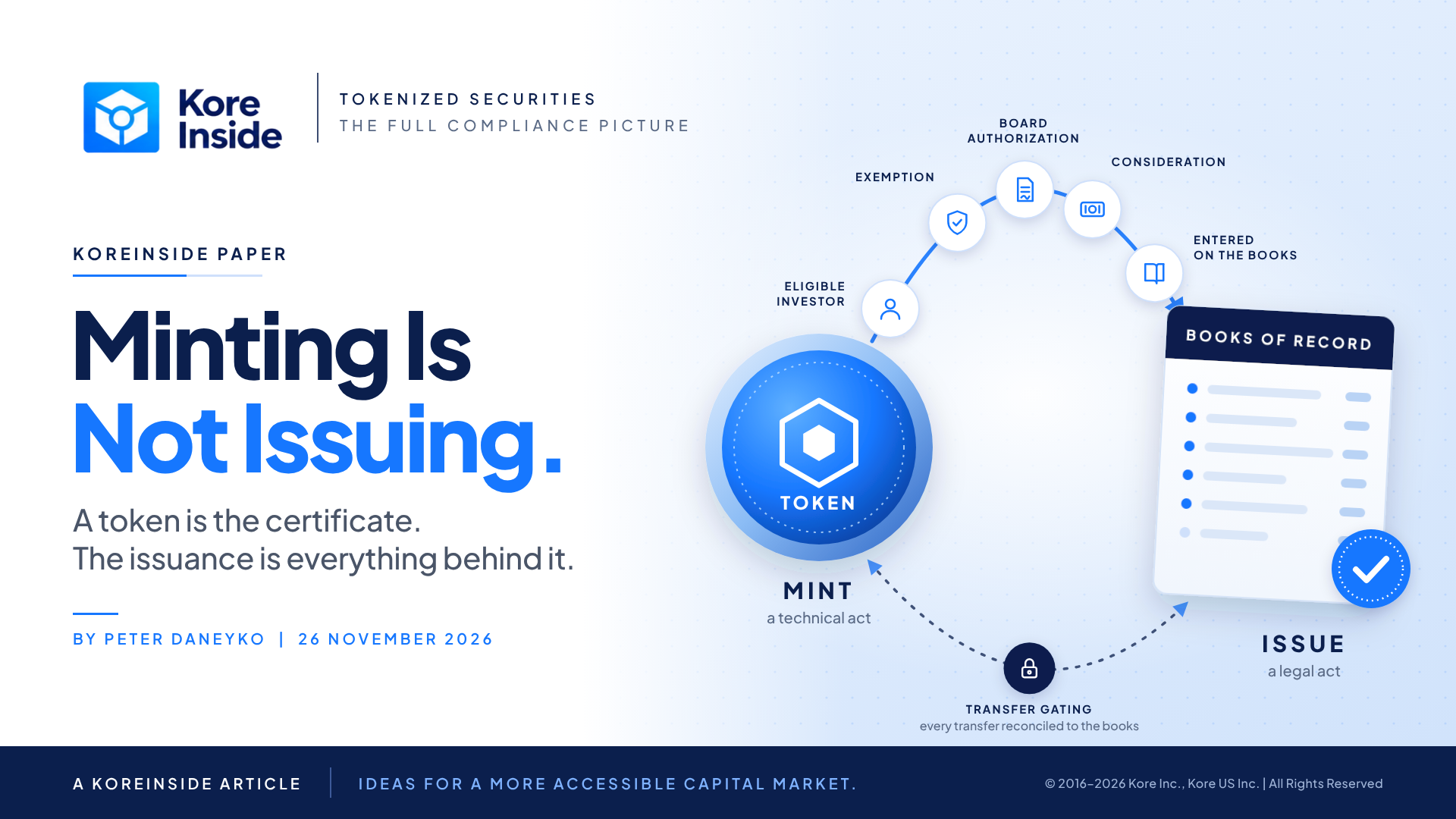
A token is the certificate. The Issuance is everything behind it.
“Wow! We could use that. We just create contracts and mint tokens for trading.”
That's what a tokenization platform told us the first time they saw our primary issuance flow, the online experience that takes an investor from interest to compliant ownership. Their reaction captures, in a few words, both the promise and the problem of tokenizing securities.
The promise: the technology side of tokenization is ready. The problem: creating a contract and minting a token is the straightforward half. It's well understood, well tooled, and increasingly commoditized. Everything that makes a minted token a lawfully issued, lawfully transferable security is the other half, and it's the half most of the market still overlooks.
This post explains that overlooked half: where the confusion in this market comes from, what separates a tokenized security from every other kind of token, what a complete compliant lifecycle looks like from the raise through ongoing trading, and how Kore provides the infrastructure underneath it. That holds whether you are transacting in tokenized securities today, or simply want the foundation in place for the day you are.
To Be Precise, and Fair
No tokenization platform claims that minting is issuing. The confusion is quieter than that: when minting is effortless and issuance machinery is absent from the stack, the mint quietly stands in for the issuance. But the two are different categories of event. Minting is a technical act, a smart contract function executes and tokens appear on a chain. Issuing is a legal act with real requirements behind it: under securities law, a sale to an eligible investor within a registration or exemption; under corporate law, board authorization, consideration received by the issuer, and ownership entered on the official record, the books maintained by the transfer agent. A minted token satisfies none of these on its own.
There is a familiar precedent. A paper stock certificate represented the security, the the official record of ownership was the entry on the Issuer's books, kept by the transfer agent. A token is potentially the certificates modern successor. Done right, it represents an issued security and stays synchronized with the legal record. Done wrong, it is a certificate for shares that were never issued.That synchronization is what the infrastructure in this post provides: mint approval only after compliance clears, every transfer reconciled to the books.
Who This Paper Is For
Three kinds of firms will recognize themselves here, and each has a different way in:
- Intermediaries transacting today — Broker-dealers, funding platforms, ATS operators, and marketplaces already facing tokenized offerings and needing the compliance rails to handle them defensibly — issuance, transfer gating, and an independent audit record.
- Intermediaries building for tomorrow — Firms with no immediate need for tokenized securities, but who understand the landscape is moving and do not want to rebuild their business when it arrives. For you, KoreInside is a foundation, not a commitment: your operations run as they do today — on your own platform, or on a white-label platform Kore builds and you brand — on infrastructure that is already tokenization-ready. When a client asks, when a regulator clarifies, when the market shifts — you switch it on rather than start over.
- Tokenization platforms and smart contract developers — The builders — in the Kore framework, the Tokenizers. You create contracts and mint tokens; what completes your offering is the compliant primary issuance in front of the mint and the compliance gating behind every transfer after it. Kore does not build contracts and does not compete with you. Together, the stack is whole.
One thing unites all three: none of you needs to become a compliance infrastructure company to operate in this market. That is the layer Kore provides.
Where the Confusion Comes From
“Token” is one of the most overloaded words in modern finance. It is used for Bitcoin, for meme coins, for digital art, for loyalty points, and for regulated securities. The word is the same; the legal reality could not be more different.
The vocabulary of blockchain was invented by and for public crypto markets: decentralized, immutable, trustless, permissionless. That vocabulary arrived first, so it shaped how everyone hears the word “token.” But a tokenized security is not a cryptocurrency that happens to represent shares. It is a security first, with everything that comes with it: registration or exemption, investor verification, transfer restrictions, transfer agent records and regulatory oversight. The token is the modern wrapper around a legal instrument that has existed for centuries. Apply crypto assumptions to it (“anyone can buy it,” “it moves freely,” “the chain is the record”) and every one of them is wrong. Each wrong assumption is a compliance failure waiting to happen.
Securities vs. Everything Else
| Crypto Assets (coins, utility tokens, NFTs) | Tokenized Securities | |
| What it represents | A network's native currency, access to a service, or a collectible. | A real security — equity, debt, or fund interests — with legal rights attached. |
| Governing rules | Protocol code and market convention. | Securities law, corporate law, and the offering's own terms. |
| Who can hold it | Anyone with a wallet. | Verified investors who pass KYC, AML, sanctions, and suitability checks. |
| How it moves | Freely, wallet to wallet, instantly and pseudoanonymously. | Only through approved transfers — lockups, jurisdiction limits, and holding rules enforced on every transaction. |
| Official record | The public chain is the record. | The transfer agent's books and records are the legal record; the chain must stay aligned with them. |
| When rules change | The protocol changes only if the community agrees. | The compliance layer adapts — new rules are enforced without rebuilding the token. |
The heart of it: crypto assets are designed to move without permission, while securities may only move with permission. The technology can be shared; the rules cannot.
The Bearer Instrument Lesson
Ever wonder why you go through an exchange, a broker, and a transfer agent to transact, rather than simply handing an instrument from one party to another?
Markets used to work exactly that way. Bearer instruments, bearer bonds, bearer shares, belonged to whoever physically held the paper. No register of owners, no identity checks, no record of transfer. It was fast, simple, and a disaster: instruments were stolen, forged, laundered, and lost with no recourse; ownership could not be proven; taxes and sanctions could not be enforced. Regulators worldwide spent decades phasing bearer instruments out, replacing them with registered ownership, intermediated settlement, and official books and records.
Now look at a crypto token in a self-custodied wallet: whoever holds the private key holds the asset, and it moves hand to hand, instantly and pseudonymously. Structurally, it is a digital bearer instrument, the very model securities markets deliberately left behind. That is not a technology critique; it is the reason a security cannot simply be “put on a blockchain” and allowed to move like a coin.
The intermediated structure of securities markets was never friction for its own sake. It is a century of hard lessons, encoded as process. Done properly, tokenization keeps the speed and precision of digital transfer while preserving everything registration achieves: verified identity, permissioned movement, and an authoritative record. And it means your role in the transaction chain becomes more important in tokenized markets, not less.
Minting Is Not Issuing: The Complete Lifecycle
Return to that tokenization platform's reaction. What impressed them was not a token contract. They can write those. It was the primary issuance flow: the online experience where an investor is verified, documents are executed, funds move, and ownership lands on the transfer agent's books, all in one continuous path. That flow looks simple on the surface precisely because the compliance machinery underneath it is doing the hard work invisibly.
A minted token with no compliant issuance behind it is the bearer instrument problem all over again, this time at birth rather than in transfer. A complete tokenized security has three stages, and each one must be governed:
| Stage | What Happens | What Kore Provides |
| 1. Raise | Investors discover the offering and invest online. | The compliant primary issuance flow: KYC,and AML screeing,broker suitability review, subscription documents, payment, and transfer agent registration — in one seamless investor experience. |
| 2. Tokenize | The Tokenizer builds the contract and Oracle; tokens are minted. | The compliance specification, audit and certification, cryptographic sealing, and the mint approval that makes minting an issuance — not just a deployment. |
| 3. Transact | Investors transfer, trade, and redeem over time; corporate actions occur. | The Oracle handshake gating every transaction, the Compliance Desk applying the rules, and the KoreNode recording every decision immutably. |
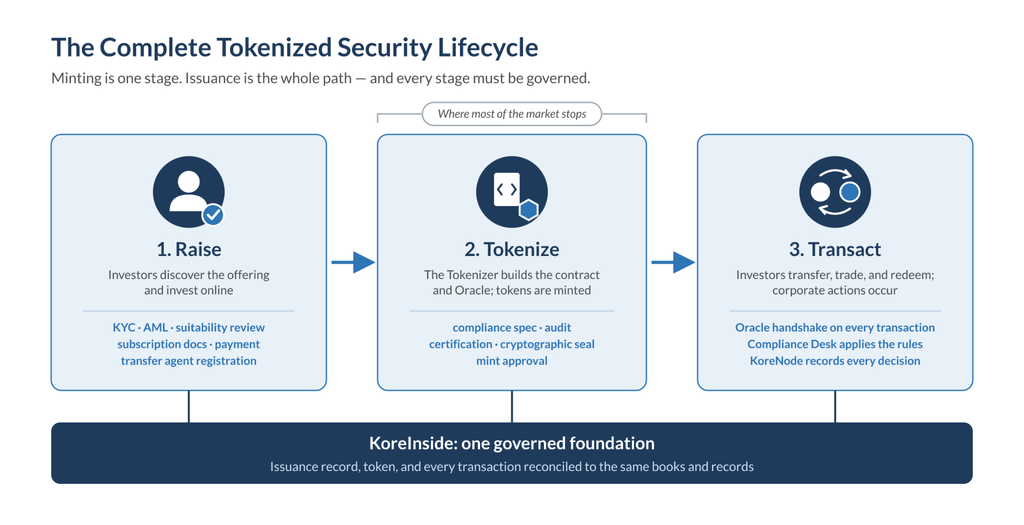
Most of the market offers stage two alone. Both the value and the regulatory defensibility come from all three stages running on one governed foundation, with the issuance record, the token and every subsequent transaction reconciled to the same books and records.
How the Infrastructure Works
Three components carry the load, each with a clear owner:
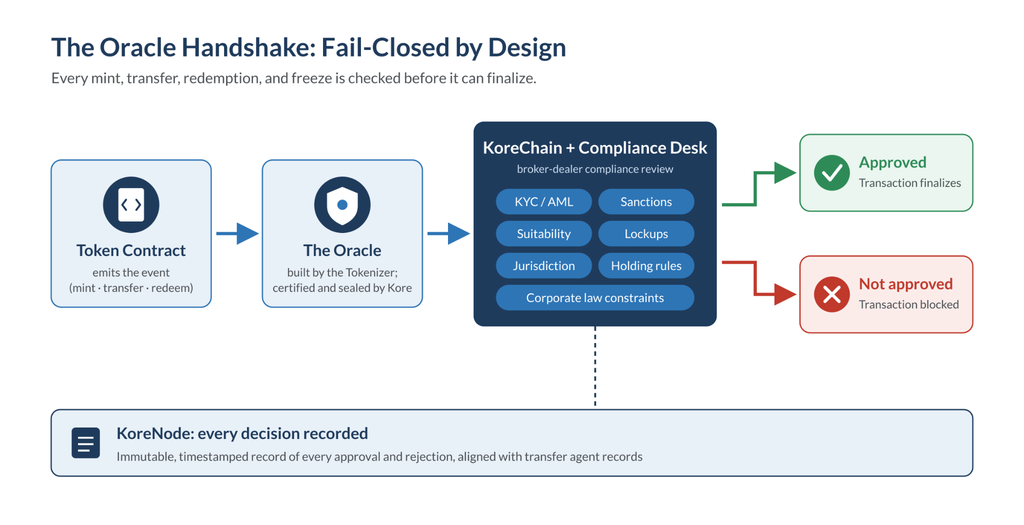
- The Oracle: The live checkpoint between the token contract and the regulated world. Every mint, transfer, redemption, and freeze passes through it: the contract emits the event, the Oracle sends it to KoreChain, the KoreInside Compliance Desk where the broker dealer’s or firm's compliance team working from their KoreInside Compliance desk evaluates KYC, AML, sanctions, suitability, lockups, jurisdiction limits, and corporate law constraints — and the transaction finalizes only on approval. Fail-closed by design: if compliance cannot approve, the transaction does not happen. The Oracle is built by the Tokenizer to Kore's API specification, then audited and certified by Kore.
- Certification and cryptographic sealing: Before going live, Kore audits the contract and Oracle end to end. Once certified, the contract bytecode and Oracle codebase are hashed and anchored inside KoreChain, linked to the offering. Any later modification changes the hash, invalidates certification, and triggers mandatory re-audit. The code that was audited is provably the code that is running.
- The KoreNode: A dedicated, permissioned node operated by Kore, holding an immutable record of every registration, approval, corporate action, and timestamped compliance decision, aligned with transfer agent records. It is isolated and auditable, with no DevOps burden on your team. When a regulator asks or a dispute arises, your answer is already written.
Kore provides the compliance specification, and the Tokenizer builds to it. Kore then validates, certifies, and seals the code on KoreChain, connecting the token to the trusted, regulated intermediaries who govern every transaction.
KoreInside: A Foundation, Not a Leap
For many intermediaries, the honest position today is this: “We do not need tokenized securities yet, but we would be foolish to bet they never arrive.” KoreInside is built for exactly that position.
With Kore infrastructure inside your operation, including a white-label platform built with Kore and branded as yours where it fits, your business runs today exactly as it should. It stays fully traditional, with issuance, investor management, transfer agent alignment, and compliance workflows all under your name. But the foundation underneath is already tokenization-ready. The same investor records, compliance engine, and books and records that govern your current offerings will govern tokenized offerings when you choose to enable them. Adding tokenization becomes a configuration decision, not a rebuild.
That optionality has concrete value:
- No regret, either way — If tokenized securities take five more years to matter in your segment, you have lost nothing — the infrastructure is earning its keep on today's business. If they arrive next quarter, you are positioned to be first to market, not scrambling.
- You move at the market's pace, not a vendor's — Enable tokenization offering by offering, client by client, as demand and regulation warrant.
- The compliance layer absorbs change — As the securities landscape evolves — and it will keep evolving — the rules engine evolves with it. Your platform, your clients, and your tokens do not get rebuilt each time a rule changes.
We Complement — We Do Not Compete
Kore is not a broker-dealer, does not operate a marketplace or funding platform of its own, and does not build tokens. Through Kore Transfer USA Inc., Kore can serve as transfer agent, maintaining the books and records that every offering, traditional or tokenized, is reconciled to. We do not raise capital, solicit investors, or compete for your clients.. Your clients remain your clients; your role remains your role; the Tokenizer's build remains the Tokenizer's build.
In fact, we don’t build competing platforms. We build white-label platforms for broker-dealers, platform operators, and tokenization providers. The investor-facing experience, including the same online issuance flow described at the start of this post, carries your brand, serves your clients, and grows your business. Kore is the infrastructure inside it: the compliant issuance engine, the specification and certification that turn a token contract into a governed security, the Oracle framework that keeps every transaction inside the rules, and the independent record that stands behind all of it. Your name on the front. KoreInside underneath
The practical meaning is simple: you can transact today, or build the foundation today and transact when you are ready, while the compliance layer adapts to an ever-changing securities landscape. Either way, you never have to choose between the technology of tokens and the rules of securities. With KoreInside, you get both.
Next step: Talk to us about where you are, whether you’re transacting now, building for later, or completing your tokenization stack. We’ll show you the issuance flow that started this conversation and what KoreInside looks like inside your business.