
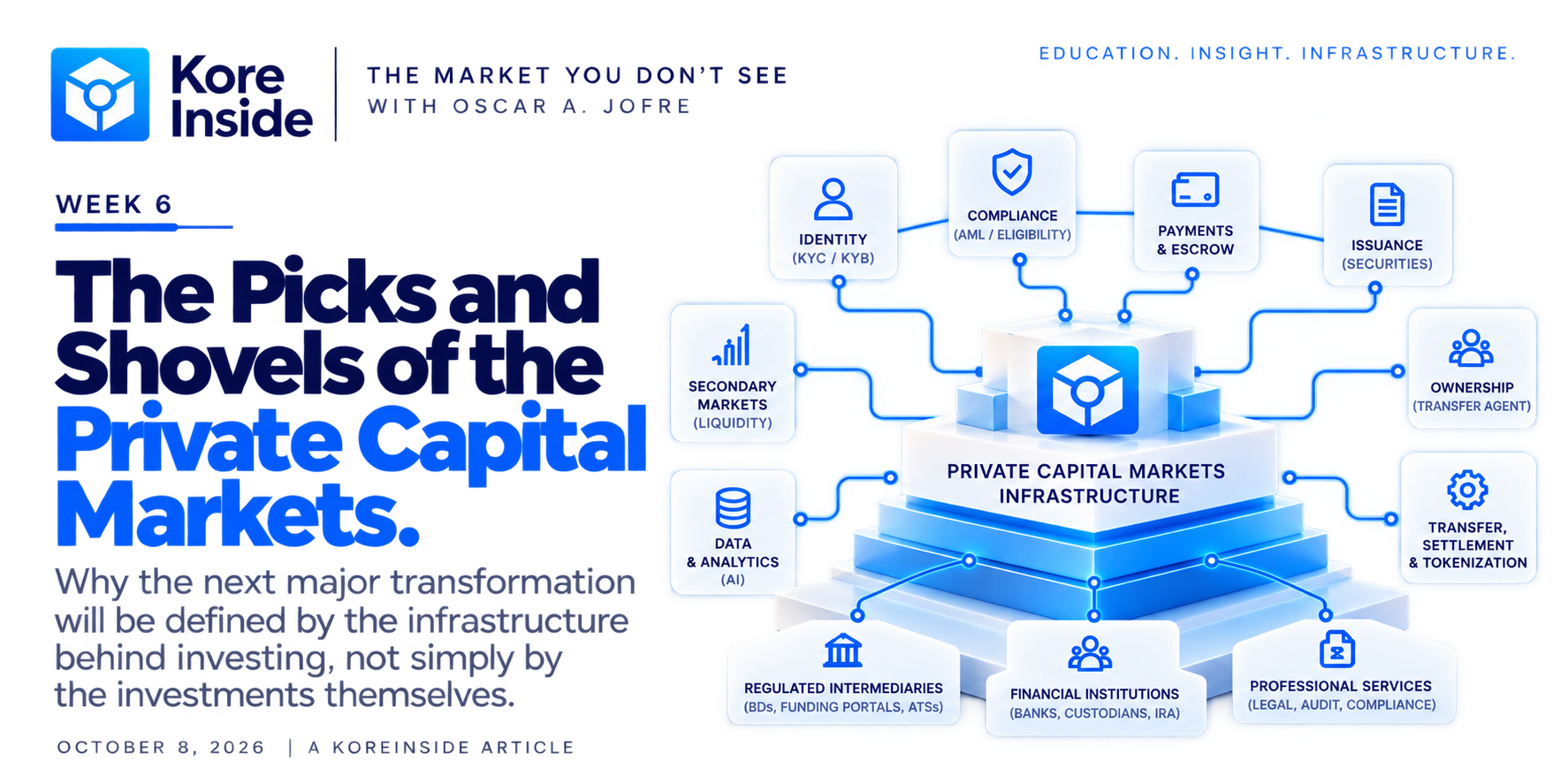
The Picks and Shovels of the Private Capital Markets
Why the next major transformation in private capital markets will be defined by the infrastructure behind investing, not simply by the investments themselves.
Understanding What Makes a Market Possible
Over the last five weeks, I've taken readers through the evolution of private capital markets.
We began by examining why private capital remains one of the least understood parts of the financial system, despite the enormous amounts of capital moving through it. We then examined how private capital historically operated through relationships, why the JOBS Act marked a major shift, and how technology began transforming the relationship between companies and investors.
In Week 4, we followed the money. We examined the trillions of dollars moving through exempt securities offerings, private equity, venture capital, private credit, and other segments of the private markets.
Last week, we examined a problem that has become increasingly visible as the market expands: the fragmentation of the infrastructure supporting private securities.
I described it as a plumbing problem in the private markets.
We have digitized many parts of capital formation, but those parts do not always work together.
This week, I want to examine what drives that problem and why I believe the infrastructure supporting private capital markets will be one of the most important areas of financial innovation over the next decade.
The conversation isn't simply about companies raising capital or investors seeking opportunities.
It is about what makes an entire capital market possible.
And that requires a very different way of looking at the industry.
1. The Investment Is Only One Part of the Market
When most people discuss private capital markets, they focus on the investment itself.
They look at the company, its valuation, its management team, its business model, the amount of capital being raised, and the potential return.
Those are important considerations. Investors should understand what they are purchasing, the rights associated with the security, and the risks involved.
But another side of the market gets far less attention.
- How does the company legally raise the capital?
- How does the investor establish eligibility?
- Who performs the applicable regulatory checks?
- Who processes the investment?
- Who holds the money?
- Who records the ownership?
- Who maintains the shareholder records?
- Who processes distributions?
- Who handles transfers?
- What happens if the company is acquired, conducts a reorganization or eventually becomes publicly traded?
- What happens if the investor wants to sell?
These questions do not disappear after the investor signs a subscription agreement.
They continue throughout the entire life of the security.
That is why I believe private capital markets must be understood as more than a fundraising process.
Capital formation is an event. Ownership is a continuing relationship.
The infrastructure has to support both.
2. What We Can Learn From the Public Markets
Consider the experience of purchasing a publicly traded security.
An investor opens a brokerage account, searches for a company, enters an order and, assuming execution, sees the resulting position.
The experience can take seconds.
But behind that transaction is an extensive network of regulated participants and infrastructure.
Broker-dealers manage client relationships and handle orders. Exchanges and other trading venues, market makers, clearing agencies, settlement systems, custodians, banks, transfer agents, market-data providers, and regulatory systems also play a role.
These participants perform different functions, but the market depends on their ability to operate together.
The public markets did not become efficient simply because someone created a website that let investors buy shares.
They became efficient through decades of investment in market infrastructure, standardization, connectivity, regulation, and operational processes.
Private capital markets have many of the same underlying requirements.
The difference is that private markets developed through a more fragmented structure.
Transactions were historically negotiated privately. Investor relationships were concentrated within professional networks. Ownership structures differed significantly. Securities were frequently subject to contractual and regulatory transfer restrictions.
There was less pressure to build standardized infrastructure that could support large numbers of individual investors across multiple platforms.
The JOBS Act and digital capital formation began changing that environment.
The regulatory pathways expanded. Technology enabled online investor acquisition and electronic transactions.
But the underlying infrastructure did not evolve at the same pace.
We made it easier to reach investors before we fully connected the systems required to support them.
That is the challenge facing the market today.
3. Identity: The Foundation of the Entire System
I believe identity is one of the most important components of private capital-market infrastructure.
Every securities transaction begins with a fundamental question:
Who is participating?
An investor may be an individual, corporation, trust, partnership, retirement account or another legal entity.
The information required to establish identity and complete applicable compliance processes varies by investor, offering, and regulated participant.
But the fundamental need remains.
The market needs trustworthy information about the parties participating in a transaction.
Today, an investor may open an account on one platform, complete identity verification, provide documents, and establish their eligibility.
Then the same investor moves to another platform and may be required to repeat much of the process.
The investor enters the same name, address, and other information.
The investor uploads identification documents again.
The investor completes another questionnaire.
The investor may be asked to verify accredited status again.
Some repetition may be legally necessary because different regulated entities have independent obligations or because information has changed. A previous verification cannot simply be treated as universally sufficient.
Nevertheless, the duplication illustrates an important infrastructure problem.
We have built digital identity processes, but we have not established broadly interoperable identity infrastructure across private capital markets.
The Opportunity: Reusable, Permissioned Identity
I believe the future will increasingly involve trusted digital identity systems that can support multiple financial relationships.
The objective is not to create a single identity database accessible to everyone.
That would introduce serious privacy, security, and governance concerns.
The objective is to allow appropriate identity information and verified attributes to be shared or reused by authorized participants, subject to applicable laws, consent, permissions and independent compliance responsibilities.
For example, a regulated participant may need confirmation that an investor's identity has been verified, without necessarily receiving every underlying document collected by another service provider.
Another participant may need current accreditation evidence.
A transfer agent may need accurate shareholder identification information.
A payment provider may need information required to process a transaction.
These are related requirements, but they are not identical.
The infrastructure should recognize those differences.
Identity should become a trusted market component, not an isolated process repeated unnecessarily at every digital doorway.
4. Compliance: From Separate Checkpoints to Connected Workflows
The second major component is compliance.
Private capital markets operate within securities laws and other applicable financial regulations.
Requirements vary by transaction.
A RegD Rule 506(b) offering is not the same as a Rule 506(c) offering.
RegCF operates through a different regulatory framework.
RegA+ has its own qualification, disclosure, and ongoing reporting requirements.
Broker-dealers, funding portals, transfer agents, banks, custodians and other participants may have different obligations.
This creates complexity.
But complexity does not mean the market should operate through disconnected processes.
Consider an investor participating in a private offering.
- Identity information may need to be collected.
- Sanctions screening or other checks may be required by the relevant participants.
- Investor eligibility may need to be established.
- Accredited-investor verification may be required.
- Documents need to be completed.
- Transaction records need to be maintained.
- Approvals may be required.
All of these activities create information.
And much of that information becomes relevant again later.
- When the offering closes.
- When securities are issued.
- When ownership changes.
- When a transfer is requested.
- When a regulated participant conducts a review.
Compliance by Design
My view is that compliance needs to become increasingly embedded in the infrastructure that supports transactions.
This does not mean software replaces legal judgment or regulatory responsibility.
It means the infrastructure should help ensure required processes occur at the right point in the transaction, exceptions are identified, and evidence is maintained.
The objective is to move away from treating compliance as an isolated administrative activity.
Instead, compliance should be part of the transaction lifecycle.
The market needs infrastructure that helps regulated participants meet their obligations, not technology that pretends those obligations no longer exist.
That distinction will become even more important as tokenization, digital assets, and secondary-market activity expand.
5. Payments and Escrow: Capital Must Move Correctly
Capital formation isn't complete when an investor expresses interest or signs a document.
Money has to move.
Depending on the offering structure, the payment process may involve a bank, escrow arrangement, payment processor, broker-dealer or another permitted participant.
Funds may be transmitted through wire transfers, ACH or other available payment rails.
Some investors may participate through retirement accounts, which can introduce additional custodial and operational requirements.
The challenge is not simply moving money electronically.
It is connecting the movement of funds to the correct investor, offering, subscription, and closing.
Consider an investor who subscribes for $50,000.
- The system needs to determine whether the subscription was accepted.
- It needs to associate the payment with that subscription.
- It needs to identify whether the correct amount was received.
- It may need to account for escrow conditions.
- It needs to determine whether the transaction is ready to close.
- If the offering does not close, the appropriate refund or return-of-funds procedures must be followed.
- If the investment closes, the financial transaction needs to connect with the securities issuance and ownership records.
This is where disconnected systems create operational risk.
An offering platform may know that an investor signed a subscription agreement.
A payment provider may know that funds arrived.
An escrow provider may know whether to release funds.
A transfer agent may need confirmation of the closing before updating ownership records.
These are different responsibilities involving different participants.
The infrastructure must connect the information without confusing or replacing the responsibilities of those participants.
The Future of Payment Infrastructure
I believe the next phase will include greater automation, stronger reconciliation and more efficient connectivity among payment systems and regulated intermediaries.
Stablecoins and other blockchain-based payment technologies may also become increasingly relevant where legally permitted and operationally appropriate.
But faster movement of money is not the same as a completed securities transaction.
The legal and operational conditions still matter.
The opportunity is to improve how money moves through the regulated transaction lifecycle.
6. Issuance and Ownership: The Market Cannot Function Without Reliable Records
Once an investment closes, the investor becomes the owner of a security.
That creates another set of responsibilities.
- What security was issued?
- How many shares or units?
- What class of security?
- What rights are attached?
- What restrictions apply?
- Who is the registered owner?
- When did the ownership begin?
- Has the security subsequently been transferred, converted, canceled, or otherwise affected by a corporate action?
Ownership records are fundamental to the market.
This is why transfer agents and ownership infrastructure play such an important role.
Transfer agents perform functions that can include maintaining security-holder records, recording changes of ownership, issuing and canceling securities, and supporting distributions and other corporate actions.
The precise responsibilities depend on the issuer, security, and applicable arrangements.
But the importance of reliable records does not change.
Why the Cap Table Is Not the Entire Solution
A capitalization table can provide important information about a company's ownership structure.
But a digital cap table is not, by itself, a complete securities infrastructure.
The broader system may also need to support legally required records, transaction histories, transfer restrictions, shareholder communications, corporate actions, distribution instructions, and the responsibilities of a transfer agent.
These systems need to remain consistent.
If a security is transferred, the ownership information needs to be updated accurately.
If a company conducts a stock split, the appropriate records need to reflect the change.
If an investor changes legal ownership through an estate or other permitted transaction, the process needs to be documented.
If a distribution occurs, the correct holder needs to receive it.
Ownership is not merely a record created at issuance. It is information that must remain accurate throughout the security's lifecycle.
That is why I believe ownership infrastructure will become increasingly important as private-market participation expands.
7. Shareholder Communications: The Relationship Continues After the Investment
One of the most overlooked parts of private capital markets is what happens after the money has been raised.
Much of the technology industry has concentrated on investor acquisition.
- How do we attract investors?
- How do we get them through onboarding?
- How do we complete subscriptions?
- How do we close the offering?
These are important activities.
But the investor relationship does not end at closing.
It changes.
- The investor is now a shareholder or other security holder.
- That relationship may continue for many years.
- The issuer may need to communicate financial updates, corporate developments, distribution information, tax documentation, voting materials, and notices about corporate actions.
- Investors may need to update their personal information.
- They may change addresses.
- They may change banking instructions.
- They may transfer holdings into permitted structures.
- They may require assistance with estate-related matters.
- They may need access to historical documents.
- The infrastructure needs to support these relationships.
This becomes especially important when an issuer has hundreds or thousands of investors rather than a small group of institutional shareholders.
A company that raises capital from 20 investors has a very different operational requirement from a company with 10,000 security holders.
Even if both companies raise the same amount of money.
Democratizing access also means scaling the responsibilities that come with ownership.
That is why shareholder communications and corporate-action infrastructure must be part of the broader capital-market architecture.
8. Secondary Markets: Trading Requires More Than Buyers and Sellers
One of the most discussed opportunities in private capital markets is secondary liquidity.
As more investors hold private securities, the question of how and when those securities may be sold becomes increasingly important.
But liquidity is often misunderstood.
Creating a digital marketplace does not automatically create liquidity.
Liquidity requires willing buyers and sellers, acceptable pricing, and the ability to complete transactions.
Private securities can also be subject to significant legal and contractual transfer restrictions.
A seller may not be permitted to transfer a security freely.
A buyer may need to satisfy eligibility requirements.
A transaction may require specific documentation or legal analysis.
A trading venue may need to operate within a regulated structure, such as an appropriately registered broker-dealer or alternative trading system, depending on the activities involved.
Funds need to move.
Ownership needs to change.
The relevant records need to be updated.
The Secondary-Market Infrastructure Challenge
I believe secondary markets will increasingly depend on connectivity between several components:
- Investor identity and eligibility.
- Security ownership and transfer restrictions.
- Regulated trading participants.
- Payment and settlement processes.
- Transfer-agent and ownership records.
- Regulatory reporting and audit trails.
These components need to work together.
A trading venue cannot solve every underlying requirement independently.
And tokenization does not eliminate those requirements.
The opportunity is to make compliant secondary transactions more operationally efficient.
That could improve the experience of buyers, sellers, issuers, and regulated participants.
But it is important to distinguish improved transaction infrastructure from guaranteed liquidity.
Technology can make a permitted transfer easier to process. It cannot guarantee that a buyer will exist.
9. Tokenization: An Evolution of Infrastructure, Not an Escape From Regulation
Tokenization has become one of the most discussed areas of financial technology.
Unfortunately, much of the conversation continues to confuse the technology used to represent an asset with the legal and regulatory framework governing that asset.
A security does not cease to be a security simply because it is represented using blockchain technology.
The rights associated with the security still matter.
The identity and eligibility of the parties may still matter.
Transfer restrictions still matter.
Ownership records still matter.
Regulated intermediaries may still have responsibilities.
Corporate actions still need to be supported.
The technology does not eliminate the legal nature of the transaction.
Where I Believe Tokenization Can Add Value
I believe blockchain technology has the potential to improve several components of capital-market infrastructure.
These include transaction auditability, programmable transfer controls, interoperability, certain aspects of settlement and the synchronization of records among authorized participants.
But the real opportunity is not simply placing a token on a public blockchain.
It is connecting the tokenized representation of the security with the legal ownership, compliance, and operational infrastructure that supports it.
For example, if a security is represented on a blockchain, the system still needs to address what happens when the holder loses access to a wallet.
It needs to address permitted transfers.
It needs to address corrections and legally required changes.
It needs to address corporate actions.
It needs to address the relationship between on-chain information and the authoritative legal ownership record.
It needs to address the responsibilities of the regulated participants involved.
This is why I believe the future of tokenization is not a competition between traditional finance and blockchain.
It is the integration of blockchain technology into regulated financial infrastructure.
That is a much more substantial opportunity than simply creating another digital token.
10. Data: The Missing Foundation of Private-Market Intelligence
Public markets benefit from extensive information infrastructure.
Market prices, financial statements, regulatory filings, corporate disclosures, analyst coverage and trading data are widely available, although access and quality vary.
Private markets operate differently.
Information can be fragmented across issuers, investment managers, intermediaries, service providers and technology platforms.
There may be no single reliable source for important information.
Valuations may be infrequent.
Transaction information may not be publicly available.
Ownership records may exist in different systems.
Investor information may be duplicated.
Corporate information may be difficult to compare.
This creates challenges for investors, issuers, intermediaries and regulators.
It also creates an opportunity.
As private-market infrastructure becomes more connected, the quality and usefulness of authorized data can improve.
That can support better reporting, operational oversight, reconciliation, risk analysis and investor communications.
But it requires more than collecting data.
It requires consistent definitions, reliable sources, permissions, security and appropriate governance.
A market cannot become more intelligent until its underlying information becomes more reliable and connected.
11. AI Will Change How the Infrastructure Operates
Artificial intelligence has the potential to become an important part of private capital-market infrastructure.
I believe its greatest value will come from improving how information is processed, analyzed, and acted upon.
Consider compliance operations.
AI-assisted systems may help identify incomplete documentation, inconsistencies, unusual transaction patterns, and exceptions requiring human review.
Consider issuer operations.
AI may help organize shareholder communications, analyze operational information and support the preparation of reports.
Consider transfer-agent functions.
AI may assist with document review, exception management and the identification of discrepancies in ownership-related information.
Consider investor education.
AI may help individuals better understand offering documents, securities structures, terminology and risks.
These are meaningful opportunities.
But AI also introduces risks involving accuracy, privacy, cybersecurity, bias, explainability, and accountability.
In regulated markets, decisions and responsibilities cannot simply be delegated to an unaccountable system.
And there is another important limitation.
AI cannot reliably solve a market-data problem if the underlying information is inaccurate, incomplete, or disconnected.
This is why I believe the infrastructure and AI conversations are closely related.
The better the infrastructure, the more useful AI can become.
12. The Private Capital Market Is an Ecosystem
At this point, I want to address something I believe is fundamental to the future of private capital markets.
No single participant performs every function.
Issuers create and issue securities.
Investors provide capital and acquire ownership interests.
Broker-dealers perform regulated securities activities.
Funding portals operate within their specific regulatory framework.
Investment banks provide advisory and capital-raising services.
Banks and payment providers support financial transactions.
Escrow providers safeguard funds under applicable arrangements.
Transfer agents maintain ownership-related records and perform designated securities administration functions.
Custodians provide custody services.
Registered investment advisers perform advisory functions.
Lawyers and auditors provide professional services.
Trading venues and their regulated participants support secondary-market activity.
Technology providers develop the systems that enable these participants to operate.
Each has a role.
Each may have different obligations.
The market depends on the integrity of those responsibilities.
That is why I do not believe the future of private capital markets is about eliminating intermediaries.
It is about connecting them.
Open Infrastructure Versus Closed Platforms
There is an important distinction between building an investment platform and building infrastructure for an entire ecosystem.
An investment platform generally focuses on the experience and operations of a particular business or distribution channel.
Infrastructure must be capable of supporting different participants, business models, regulatory pathways and transaction structures.
- A broker-dealer may need to work with multiple issuers.
- An issuer may need to work with multiple distribution partners.
- An investor may hold securities from many different issuers.
- A transfer agent may maintain records for securities distributed through different channels.
- A custodian may support assets originating from different platforms.
- A secondary-market participant may need to interact with ownership records maintained elsewhere.
If every platform becomes a closed environment, the market remains fragmented.
If infrastructure can connect those environments securely and appropriately, the entire ecosystem can become more efficient.
I believe the private capital markets need more collaboration and interoperability, not more isolated financial technology environments.
13. What This Means for Companies Raising Capital
For issuers, connected infrastructure can create benefits that extend well beyond fundraising.
- A company may be able to manage investor onboarding more efficiently.
- Subscription information may flow more accurately into closing processes.
- Payment reconciliation may improve.
- Ownership records may be updated more consistently.
- Shareholder communications may become easier to manage.
- Corporate actions may become less operationally burdensome.
- Historical information may be more accessible to authorized participants.
The issuer may also be better prepared for future financing rounds, changes in ownership structure, acquisitions or other corporate events.
The objective is not simply to make it easier for a company to raise money.
It is to help the company manage the responsibilities created by raising that money.
That distinction becomes increasingly important as the shareholder base grows.
14. What This Means for Investors
For investors, connected infrastructure can potentially reduce unnecessary repetition and improve access to reliable information.
- Identity information may become easier to manage.
- Compliance processes may become more consistent.
- Investment documentation may become easier to access.
- Ownership records may become more transparent to the holder.
- Communications may become more organized.
- Distribution instructions may become easier to maintain.
- Permitted transfers may become more efficient.
- But none of these improvements eliminates investment risk.
- A better investment experience does not make an underlying company more valuable.
- A digital security is not necessarily more liquid than a traditional security.
- An automated compliance process does not guarantee that an investment is appropriate.
- A tokenized security can still lose its entire value.
Infrastructure improves how a market operates.
It does not remove the economic risks of the assets traded within that market.
That is a distinction every investor needs to understand.
15. What This Means for Regulated Financial Institutions
I believe regulated intermediaries will be among the most important beneficiaries of better infrastructure.
Broker-dealers need reliable systems for investor information, transaction oversight, documentation, and records.
Funding portals need technology that supports their regulatory responsibilities and operational workflows.
Transfer agents need accurate information about issuances, ownership, transfers and corporate actions.
Banks and payment providers need reliable transaction information.
Custodians need accurate records and appropriate connectivity.
Investment advisers need access to dependable information relevant to their responsibilities.
As private markets become more digital, these participants will increasingly need technology that connects them with other parts of the transaction lifecycle.
That does not mean all institutions should use identical systems.
It means their systems should be capable of exchanging appropriate information securely and accurately.
This is why I believe the most important financial infrastructure will be designed around the needs of the ecosystem rather than the needs of one isolated application.
16. The Economics of Infrastructure
There is another reason I believe investors and market participants should pay attention to infrastructure.
Infrastructure businesses operate differently from the companies using their services.
A company raising capital may complete one offering and not return to the market for several years.
But the infrastructure supporting that offering may remain relevant throughout the life of the security.
- Identity records may need to be maintained or refreshed.
- Compliance records may need to be retained.
- Ownership records need to remain accurate.
- Shareholder communications continue.
- Distributions may occur.
- Corporate actions may arise.
- Transfers may take place.
- Secondary transactions may eventually become possible.
This creates a different economic relationship.
Rather than focusing only on the moment capital is raised, infrastructure providers can potentially support ongoing services across the securities lifecycle.
The commercial model may include transaction fees, recurring software fees, recordkeeping services, payment processing, connectivity, compliance services or other arrangements, depending on the provider.
But infrastructure businesses also face substantial challenges.
They require significant investment in security, reliability, integration, regulatory expertise, customer support, and long-term operations.
- Revenue is not guaranteed.
- Margins depend on business model and execution.
- Technology can become obsolete.
- Regulatory requirements can change.
- Large financial institutions can be difficult to integrate.
- Network effects are possible, but they should not be assumed.
That is why I believe infrastructure should be evaluated based on the value it delivers, its reliability, adoption, economics and ability to serve the market over time.
The opportunity may be substantial.
So are the responsibilities.
17. Why Standards Will Become Increasingly Important
As the market becomes more connected, another issue becomes unavoidable.
Standards.
- How should investor identity information be represented?
- How should issuers and securities be identified?
- How should transaction data move between participants?
- How should ownership information be reconciled?
- How should transfer restrictions be communicated?
- How should payment and settlement information be linked to the relevant transaction?
- How should regulatory records be maintained?
- How should systems communicate across different technology providers?
These questions cannot be solved effectively if every participant creates an entirely incompatible approach.
Standards do not require every organization to use the same technology.
They establish common expectations and methods that allow different technologies to work together.
We have seen the importance of standards across banking, payments, public securities markets and many other industries.
I believe the private capital markets are reaching a point where greater standardization will become increasingly important.
This includes technical standards, operational standards, data standards and compliance-related interoperability.
The objective should be a market in which different regulated participants and technology providers can collaborate without requiring every transaction to be reconstructed from the beginning.
Open standards and connected infrastructure can help transform a collection of private-market platforms into a more coordinated financial ecosystem.
18. My View: The Next Decade Will Be Defined by Infrastructure
When I look at the evolution of private capital markets, I see three broad stages.
The first stage was relationship-driven capital formation.
Companies found investors through professional networks, financial intermediaries, and existing relationships.
The second stage was digital capital formation.
The JOBS Act helped expand regulatory pathways. Technology made online investor acquisition, digital onboarding, electronic subscriptions and digital payments increasingly possible.
We are now moving into what I believe will become the third stage.
Connected private capital-market infrastructure.
This stage is not defined by one website, one application, one blockchain or one financial institution.
It is defined by how the market operates as a whole.
Identity needs to connect with compliance.
Compliance needs to connect with the transaction.
The transaction needs to connect with payments.
Payments need to connect with issuance.
Issuance needs to connect with ownership.
Ownership needs to connect with shareholder communications.
Ownership needs to connect with transfers and secondary-market activity.
And all of those components need reliable data, security, regulatory controls and auditability.
That is the architecture I believe private capital markets increasingly require.
It is also why I have spent so much of my career focused on infrastructure.
My work at KoreInside has been shaped by the conviction that capital markets are ecosystems and that the systems supporting them must be capable of working together.
I mention that experience not because this article is intended to promote a product, but because it explains the perspective from which I am writing.
I have seen the challenges created when identity, compliance, payments, ownership and other processes operate independently.
I have also seen how difficult it can be for regulated participants to connect systems that were never designed to work together.
Those experiences have reinforced my belief that the next major transformation will not come simply from digitizing another isolated activity.
It will come from connecting the activities and participants that make private capital markets function.
19. What Investors Should Watch Over the Next Decade
If you are trying to understand where the private capital markets are heading, I believe several developments deserve close attention.
First, the evolution of digital identity and the ability to reuse trusted information appropriately across financial relationships.
Second, integrating compliance into transaction workflows.
Third, modernizing payments, escrow, and settlement connectivity.
Fourth, the continued development of reliable ownership and transfer-agent infrastructure.
Fifth, the growth of compliant secondary-market capabilities, while recognizing that better infrastructure does not guarantee liquidity.
Sixth, the integration of tokenization into regulated securities operations.
Seventh, the development of common data and interoperability standards.
Eighth, the application of AI to better-connected, reliable private-market information.
And finally, the ability of different regulated participants to work together through open infrastructure rather than isolated platforms.
These developments will not all occur at the same speed.
Some will advance quickly.
Others will face regulatory, commercial and operational challenges.
Some technologies will succeed.
Others will disappear.
But I believe the direction is becoming clearer.
The private capital markets are moving toward greater connectivity, automation and interoperability.
20. The Investment Is What You See. The Infrastructure Is What Makes It Possible.
Throughout this series, I have encouraged readers to look beyond the familiar financial-market headlines.
Private capital is much larger and more complex than most people realize.
It involves companies at different stages of development, different types of investors, multiple regulatory pathways, and an extensive network of financial intermediaries.
Technology has expanded access.
But access is only one part of the market.
For capital formation to operate efficiently at scale, the infrastructure must support the entire lifecycle of a security.
From the moment an investor is identified to the moment a security is issued, held, serviced, transferred, or ultimately canceled.
That requires more than a digital investment portal.
- It requires identity, compliance, payments, ownership, communications, data and the regulated participants that support them.
- It requires interoperability.
- It requires trust.
- It requires standards.
- And it requires long-term investment in the systems that make financial markets function.
This is why I believe the picks and shovels of private capital markets deserve much more attention.
Not because infrastructure eliminates investment risk.
Not because every infrastructure company will succeed.
And not because technology can replace the responsibilities of regulated institutions.
But because a market cannot grow indefinitely without the systems required to support its growth.
We opened the market before we finished building the infrastructure.
Now we have the opportunity to build the infrastructure that the next generation of private capital markets will require.
That is where I believe one of the most important transformations in financial markets will take place.
Next Week: Where I Believe the Private Capital Markets Are Going
Over the last six weeks, we have examined where private capital came from, how the JOBS Act changed capital formation, how much capital moves through these markets, why the infrastructure remains fragmented and what needs to be built next.
Next week, I want to bring those ideas together and look forward.
I will share my perspective on how the private capital markets may evolve over the next decade.
We will examine the future of investor access, digital identity, compliance, ownership, payments, secondary markets, tokenization, AI and the relationship between traditional financial institutions and emerging technologies.
We will also explore why I believe the private capital markets are approaching an important transition from digital platforms to connected financial infrastructure.
Week 7: My Thesis for the Next Decade of Private Capital Markets.
Because understanding where capital is moving is important.
Understanding what must be built to support that capital is equally important.
And understanding where the market is going is what allows us to prepare for what comes next.
Oscar A. Jofre
Co-founder & CEO
KoreInside
THE MARKET YOU DON'T SEE
with Oscar A. Jofre
Education. Insight. Infrastructure.
Regulatory and Educational References
For readers who want to explore the regulatory and market infrastructure discussed in this article, I recommend beginning with the following primary sources:
- U.S. Securities and Exchange Commission — Exempt Offerings: https://www.sec.gov/resources-small-businesses/exempt-offerings
- SEC — Regulation Crowdfunding: https://www.sec.gov/resources-small-businesses/exempt-offerings/regulation-crowdfunding
- SEC — General Solicitation under Rule 506(c): https://www.sec.gov/resources-small-businesses/exempt-offerings/general-solicitation-rule-506c
- SEC — Regulation D Offering Statistics: https://www.sec.gov/data-research/statistics-data-visualizations/regulation-d-offerings
- SEC — Transfer Agents: https://www.sec.gov/about/divisions-offices/division-trading-markets/transfer-agents
- FINRA — Alternative Trading Systems: https://www.finra.org/registration-exams-ce/broker-dealers/alternative-trading-systems