
Every so often, an entrepreneur asks me a question that seems simple on the surface but carries enormous implications.
"Oscar, what's the best regulation to raise capital under?"
It's a fair question. After all, the United States has created several exemptions to help companies access capital. Regulation D (RegD). Regulation Crowdfunding (RegCF). Regulation S (RegS). Regulation A+ (RegA+). Each serves a purpose, and each has its place.
But after more than two decades working in private capital markets, I don't think that's the right question anymore.
The better question is this:
If you could design the perfect regulation for private capital markets today, knowing everything we know about technology, investors, liquidity, tokenization, and the future of ownership, what would it look like?
Every generation has an opportunity to redefine how capital markets operate. Sometimes that change comes from technology. Sometimes it comes from regulation. The most meaningful transformation occurs when regulation and technology evolve together because that is when entirely new markets emerge.
During the past two decades, I have had the privilege of working with entrepreneurs raising their first round of capital, institutional investors deploying billions of dollars, regulators modernizing securities laws, and financial institutions building the infrastructure that supports capital formation. Those experiences have shaped how I think about private markets. They have also convinced me that our industry often begins the conversation in the wrong place.
Whenever founders start planning a capital raise, they usually ask which exemption they should use. It is a logical question because every regulation appears to solve a different problem. Regulation D is designed for one purpose. Regulation Crowdfunding serves another. Regulation S opens international opportunities. Regulation A+ occupies its own place within the regulatory landscape. While each regulation has value, I have come to believe that choosing an exemption should never be the starting point. The real discussion should focus on where the company intends to be ten or twenty years from now.
Too often we approach capital formation as though each financing is an isolated event. In reality, every financing is simply another milestone in the life of a business. Companies are not created to complete a single capital raise. They are built to grow, attract investors, create long-term value, and eventually provide liquidity for their shareholders. Some will remain private for decades. Others will pursue a listing on Nasdaq or the New York Stock Exchange. Regardless of the destination, every company follows a continuous journey. The regulatory framework should support that journey instead of forcing companies to rebuild their ownership structure every time they reach a new stage of growth.
That realization led me to ask a different question. If we were designing private capital markets today, with everything we have learned about digital technology, artificial intelligence, blockchain, identity, and investor expectations, what would the ideal regulation look like?
The answer became surprisingly clear.
The perfect regulation would begin with participation. Innovation should never become the privilege of only a small percentage of investors. Throughout history, many of the world's most successful companies created extraordinary value before the broader investing public had any opportunity to participate in that growth. I believe we can do better. The future of private capital markets should encourage responsible participation from a broader community of investors while maintaining the regulatory safeguards that protect market integrity. Companies become stronger when customers, employees, families, and communities have the opportunity to become owners. Ownership creates a level of engagement that cannot be replicated through marketing or customer loyalty programs. People who own a piece of a company become ambassadors for its mission because their success is tied directly to the success of the business.
A broader shareholder base naturally leads to another important consideration. For years the industry viewed a large number of shareholders as an administrative burden. That perception was understandable when ownership records were managed through manual processes and paper documentation. Today, the technology supporting private markets has fundamentally changed. Transfer agents operate on sophisticated digital platforms. Identity verification is automated. Electronic communications and voting have become standard practice. Artificial intelligence is beginning to automate many of the repetitive compliance and administrative functions that once consumed enormous resources. Technology has removed many of the barriers that previously limited shareholder growth. As a result, companies should no longer structure themselves around outdated operational constraints. The next generation of market leaders will build large shareholder communities because ownership has become easier to manage than at any point in history.
The conversation inevitably turns toward tokenization, and this is where I believe much of the industry loses its focus. Discussions often begin with blockchain networks, digital wallets, or cryptocurrencies. Those technologies are certainly important, but they are not the foundation of successful capital markets. Compliance remains the foundation. A security continues to be a security regardless of whether ownership is represented by a traditional book-entry record or a digital token. Technology does not replace securities law. Technology provides a more efficient method of implementing it.
That distinction changes the conversation completely. Instead of asking whether blockchain can replace traditional financial infrastructure, we should ask how blockchain can strengthen it. Digital securities held in wallets such as Phantom or MetaMask and issued on networks such as Ethereum, Solana, Avalanche, or Base become significantly more valuable when they remain connected to regulated ownership records through compliant infrastructure. Investors receive the convenience and efficiency of modern technology while regulators, transfer agents, and issuers preserve the integrity of the official shareholder record. This is not a conflict between innovation and regulation. It is an example of innovation making regulation stronger.
Once ownership becomes digital, investors begin asking another important question. They want to understand what happens after they invest. For decades, private investing carried an expectation that capital would remain locked away for years with little opportunity for liquidity. Investors accepted that limitation because there were few alternatives. Today's investors think differently. They understand that private companies require long-term capital, but they also expect markets to evolve. They want the possibility of secondary trading when it can occur within a compliant regulatory framework. Liquidity should not be viewed as the opposite of long-term investing. In healthy markets, liquidity encourages participation because investors know they have options if circumstances change. Companies benefit as well because broader investor participation often follows markets that provide confidence and flexibility.
Trust remains the common thread connecting every successful capital market. Investors are willing to commit capital when they believe information is accurate, timely, and transparent. That confidence does not emerge from marketing campaigns or investor presentations. It comes from consistent disclosure. Regulations that encourage transparency strengthen the relationship between companies and their shareholders. Entrepreneurs sometimes view ongoing reporting obligations as an administrative expense. I view them differently. Transparent companies reduce uncertainty. Lower uncertainty reduces perceived risk. Lower risk increases investor confidence. Confidence ultimately lowers the cost of capital. Disclosure is not simply a legal obligation. It is one of the most valuable strategic assets a company can possess.
As companies mature, many founders begin considering whether they should pursue a public listing. An initial public offering is often described as the finish line, but I have never shared that perspective. Becoming a public company is simply another stage in the evolution of ownership. Companies that have already embraced governance, shareholder communications, transparency, and regulatory discipline find themselves significantly better prepared for that transition. While Regulation A+ does not automatically qualify a company for Nasdaq or the New York Stock Exchange, it encourages many of the practices that public markets expect from successful issuers. Companies that build those disciplines early gain an advantage because they are strengthening their organization long before they decide to pursue a listing.
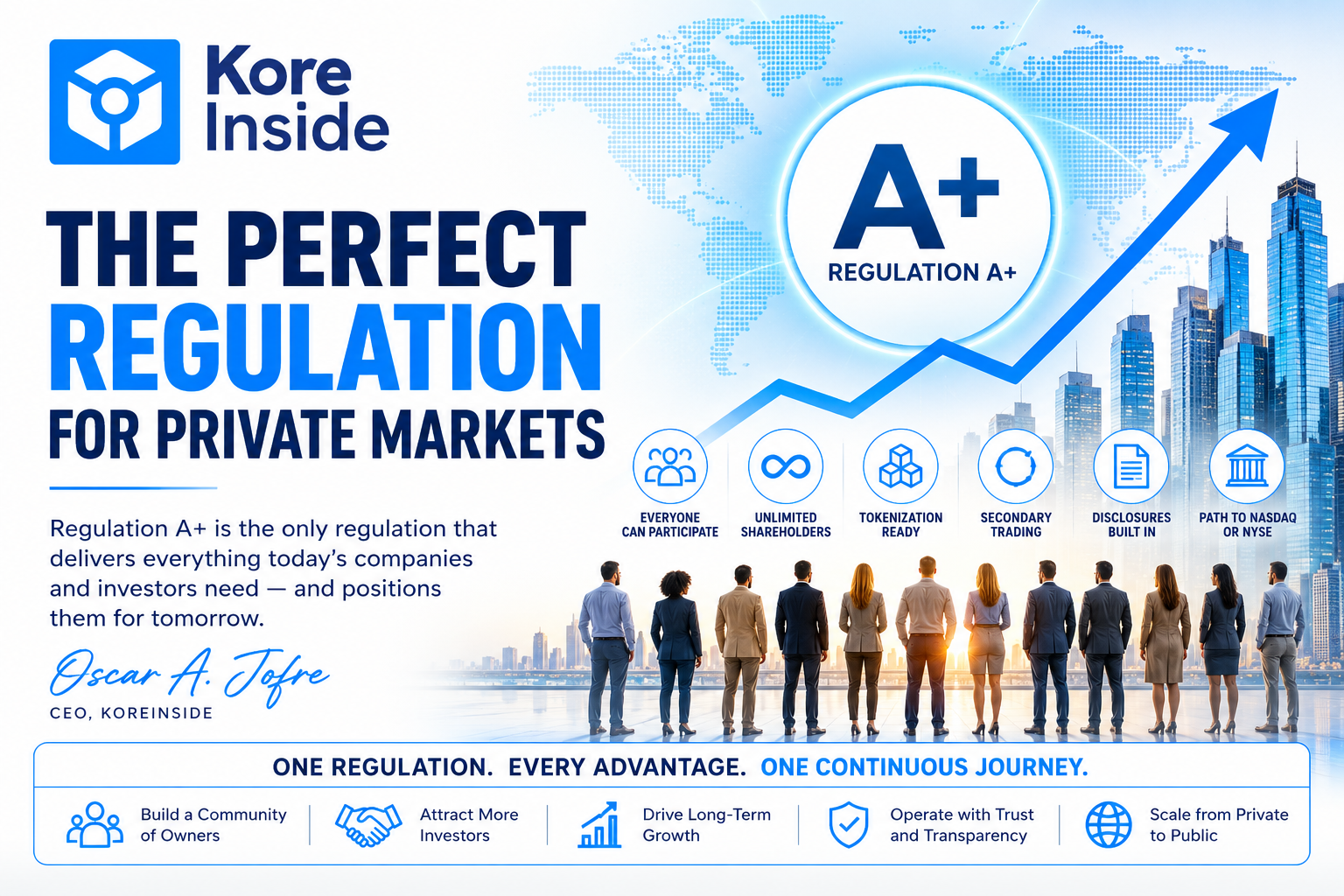
When I consider everything companies need to succeed over the coming decades, I continue to arrive at the same conclusion. Regulation A+ comes closer than any other exemption to supporting the complete lifecycle of a modern company. It encourages broader investor participation, supports substantial shareholder communities, provides a framework that aligns well with digital ownership, promotes transparency through ongoing disclosure, creates opportunities for compliant secondary trading, and helps companies develop the governance practices that will serve them well if they eventually choose to enter the public markets.
That does not mean Regulation A+ is perfect. Every regulation can evolve. Our industry still needs stronger secondary market infrastructure, clearer guidance surrounding tokenized securities, and greater interoperability between regulated participants. These are important conversations that will shape the next generation of capital markets. Fortunately, they are conversations that are already taking place.
At KoreInside, our vision has always extended beyond a single capital raise or a single regulation. We believe ownership should remain continuous throughout the entire life of a company. The infrastructure supporting formation, capital raising, shareholder management, governance, proxy voting, tokenization, secondary trading, and eventually a public listing should function as one connected ecosystem. Companies should not replace their ownership infrastructure every time they grow. Their infrastructure should evolve alongside them.
I believe the future of private capital markets will not be defined by blockchain alone, artificial intelligence alone, or any individual technological breakthrough. It will be defined by the creation of a continuous ownership model that allows companies and investors to move seamlessly through every stage of growth. In my view, Regulation A+ provides the strongest regulatory foundation available today to support that vision. The companies that recognize this opportunity today will not simply adapt to the future of private markets. They will help define it.