
Why the Next Stage of Private Capital Markets Is Not Another Investment Platform. It Is Connected Infrastructure.
For the first four weeks of this series, I have been explaining the private capital markets from the outside in.
We started with the market itself and why so many investors rarely see it. We went back to the period when private capital was largely relationship-driven and “by appointment only.” We examined how the JOBS Act changed capital formation and created new pathways for companies and investors to connect. Last week, we followed the money and saw just how significant private and exempt capital formation has become.
Now I want to go underneath the market.
Because after spending years working inside private capital markets, I believe one of the biggest misunderstandings is that the industry still has a technology problem.
We don't.
There is plenty of technology.
We have investor portals. KYC providers. Payment systems. Electronic signatures. Cap tables. Transfer-agent technology. CRM systems. Data rooms. Broker-dealer platforms. Funding portals. Banking APIs. Blockchain networks. Digital wallets. Secondary-market technology. AI.
The problem is different.
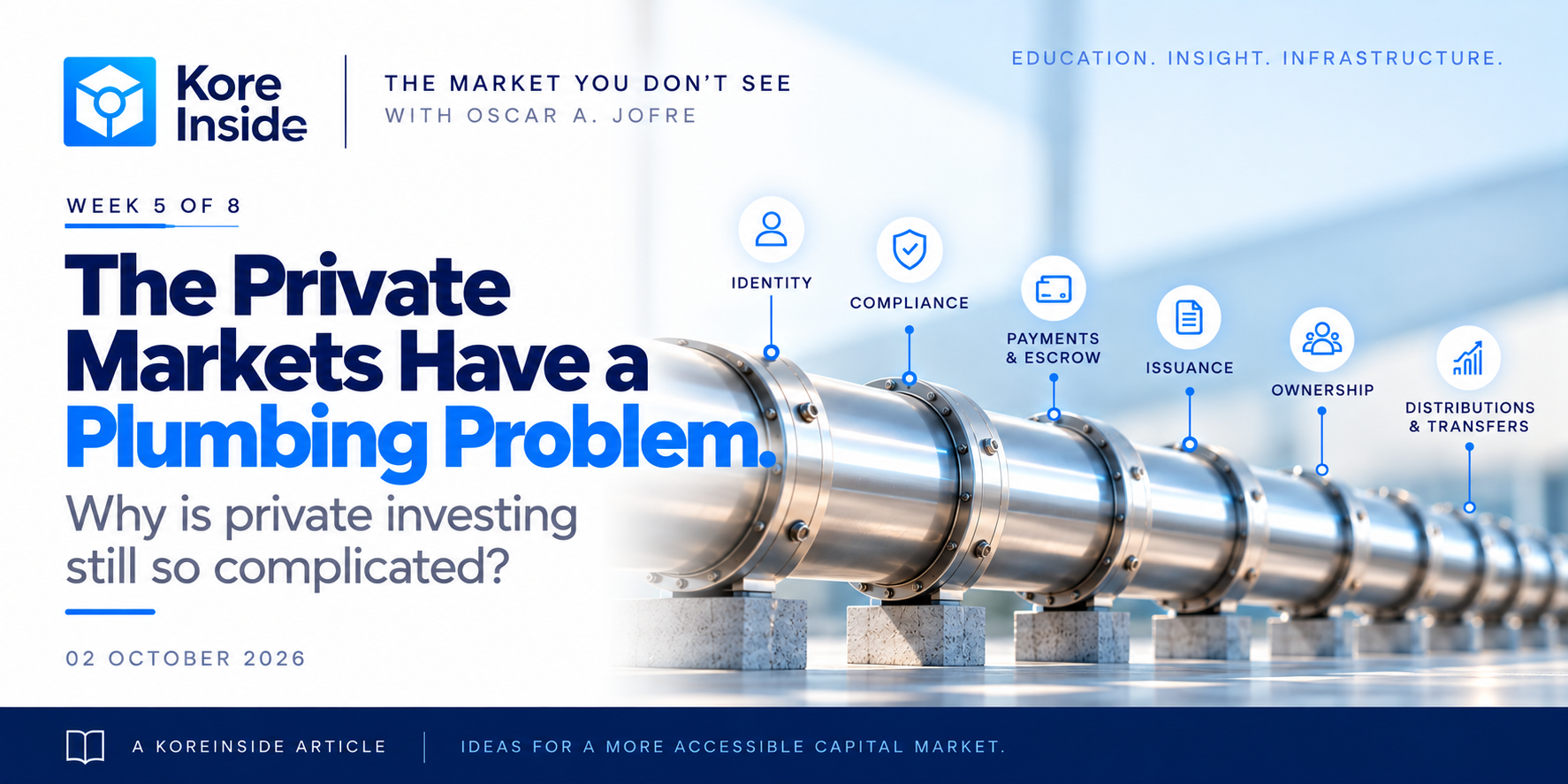
The private capital markets have a plumbing problem.
We have spent more than a decade digitizing individual pieces of the capital-formation process. What we have not done nearly as well is connect those pieces into infrastructure that can support the complete lifecycle of a private security.
That distinction is going to become increasingly important.
Because putting an INVEST button on a website is relatively easy.
Building everything that must happen behind that button is not.
The INVEST Button Is Not the Market
Let's start with the investor.
- An investor discovers a private-company offering.
- They review the company.
- They review the offering documents.
- They decide they want to invest $25,000.
- They click:
INVEST
From the investor's perspective, that may appear to be the transaction.
From the market's perspective, it is only the beginning.
A securities transaction is not an e-commerce purchase.
The investor cannot simply put 1,000 shares into a shopping cart, enter a credit card and wait for the package to arrive.
Depending on the exemption, security, investor, intermediary and transaction structure, a series of regulatory, financial and operational processes may have to occur.
- Who is this investor?
- Is the identity authentic?
- Is the investor an individual or an entity?
- What information must be collected?
- What regulatory checks apply?
- Is the investor eligible for this offering?
- Does accredited-investor status matter?
- Does it need to be verified?
- Has the investor reviewed and executed the appropriate documents?
- Where is the investor's money going?
- Does the transaction involve escrow?
- Has the subscription been accepted?
- Has the offering met its closing conditions?
- What security is being issued?
- How many securities?
- At what price?
- Who records ownership?
- What restrictions apply to the security?
- Who maintains the ownership record?
- How does the issuer communicate with the shareholder?
- How are distributions handled?
- What happens when the shareholder changes an address, bank account or tax information?
- What happens if the investor dies?
- What happens if the security is transferred?
- What happens if the company conducts a corporate action?
- What happens if the investor eventually wants to sell?
That is the private capital market most investors never see.
And virtually every one of those questions requires data to move from one participant or system to another.
Follow One Investor Through the System
This is where the fragmentation becomes easier to understand.
Imagine that Sarah wants to invest $25,000 in a private company.
The specific requirements will depend on the offering and the regulated participants involved, but a typical digital journey can touch many different systems.
1. Discovery
Sarah first needs to discover the company.
That could happen through a broker-dealer, funding portal, marketplace, issuer website, investment bank, registered investment adviser, referral network, marketing campaign or another permitted channel.
Even this first step is regulated differently depending on the offering.
For example, Rule 506(b) prohibits general solicitation, while Rule 506(c) permits broad solicitation if its conditions are satisfied, including that all purchasers are accredited investors and the issuer takes reasonable steps to verify their accredited status. SEC
RegCF has a different architecture. The SEC requires transactions under RegCF to occur online through an SEC-registered broker-dealer or funding portal, and an eligible issuer may currently raise up to $5 million during a 12-month period. SEC
The first lesson is therefore important:
There is no single private-market investor journey.
The regulatory pathway affects the infrastructure.
2. Identity
Sarah creates an account.
Now the system needs to know who Sarah actually is.
- Name.
- Address.
- Date of birth.
- Contact information.
- Tax information.
- Identification documents.
- Potentially information about citizenship or residency.
If Sarah is investing through an entity, the information requirements can expand substantially.
- What type of entity?
- Who controls it?
- Who is authorized to act for it?
- Who are the beneficial owners?
- What supporting documents are required?
This is where identity becomes much more than login credentials.
An email address and password tell a platform that somebody has access to an account.
They do not establish everything a regulated financial transaction may need to know about the person or entity behind the account.
And this is the beginning of one of the industry's largest inefficiencies.
Sarah may already have provided much of this information somewhere else.
But when she enters another private-market environment, she may be asked to do it again.
And again.
And again.
We digitized identity collection.
We have not fully solved portable identity.
3. Compliance
Now Sarah moves into compliance.
This is where people sometimes make the mistake of thinking KYC, AML, investor eligibility and accredited-investor verification are all the same thing.
They are not.
Different requirements answer different questions and may attach to different participants or transactions.
The compliance process may involve identity verification, sanctions checks and other procedures depending on the parties and applicable rules.
Then there is investor eligibility.
If Sarah is participating in a Rule 506(c) offering, for example, the SEC requires all purchasers to be accredited investors and requires reasonable steps to verify that status. The SEC describes this as a facts-and-circumstances analysis and also provides non-exclusive verification methods. SEC
Notice what has happened.
Sarah has moved from:
Who are you?
to:
Are you permitted or qualified to participate in this particular transaction?
Those are different questions.
Yet much of the data required to answer them overlaps.
This is precisely where connected infrastructure becomes valuable.
4. The Offering and Subscription
Sarah has now been identified and, where required, qualified for the offering.
- She still has not purchased anything.
- She needs to review the offering materials.
- She may need to acknowledge disclosures.
- She needs to complete a subscription agreement.
- She may need to make representations about herself.
The issuer may need to accept the subscription.
Electronic signatures have dramatically improved this process.
But electronic signatures solve one part of the transaction.
They do not automatically connect the information in the signed document to every other participant who may require it.
That is an important distinction.
Digitizing a document is not the same thing as digitizing the transaction.
5. Money
Now Sarah wants to send $25,000.
Where does it go?
Again, that depends on the transaction.
- Bank account?
- Escrow?
- Qualified third party?
- Credit Card?
- Wire?
- ACH?
- Crypto?
- IRA?
- RIA?
- Brokerage Account?
- Another permitted payment rail?
- Who confirms receipt?
- How is the payment matched to Sarah?
- What happens if Sarah sends the wrong amount?
- What happens if the payment comes from an account with a different name?
- What happens if the offering does not close?
- How is the money returned?
For RegCF, the structure is particularly instructive. SEC guidance explains that funding portals cannot hold, manage, possess or handle investor funds or securities; the regulatory framework instead contemplates qualified third parties for handling funds. SEC
That demonstrates something fundamental about financial infrastructure.
The participant collecting the investment information is not necessarily the participant holding the money.
The systems therefore have to communicate.
6. Closing
Sarah has completed the subscription and sent her funds.
She still may not yet be a shareholder.
The offering may have closing conditions.
The issuer may need to accept the subscription.
Funds may need to be released.
Documents may need to be reconciled.
The number of securities needs to be calculated.
The transaction needs to be recorded.
This is where capital formation turns into ownership.
And ownership is not simply another field in the investor's online profile.
It is a legal record.
7. Ownership
Sarah now owns the security.
What happens next?
- Somebody has to know:
- What she owns.
- How much she owns.
- When she acquired it.
- What class of security she owns.
- What price she paid.
- What restrictions apply.
- What rights attach to the security.
- What transactions have occurred since issuance.
This is where transfer-agent and ownership infrastructure becomes important.
The SEC describes transfer agents as performing functions that include recording changes of ownership, maintaining issuer security-holder records, issuing and cancelling certificates and distributing dividends. The SEC also emphasizes their importance to successful secondary transactions. SEC
This is not administrative trivia.
Ownership is infrastructure.
If we cannot reliably determine who owns the security, everything downstream becomes more difficult.
- Distributions.
- Voting.
- Corporate actions.
- Tax reporting.
- Transfers.
- Secondary trading.
- Issuer communications.
- Eventually settlement.
The integrity of the ownership record sits underneath all of it.
8. The Investor Becomes a Shareholder
This is another place where I believe the industry has focused too much on acquisition and not enough on lifecycle.
Companies spend enormous amounts of energy acquiring investors.
But after the investment closes, that investor becomes something different.
A shareholder.
That relationship can last years.
The shareholder may need:
- Statements.
- Company updates.
- Financial information.
- Tax documents.
- Distribution notices.
- Voting materials.
- Corporate-action information.
- Changes to their account.
- Beneficiary updates.
- Banking changes.
- Transfer assistance.
- Support.
The capital-formation transaction may take days or weeks.
The ownership relationship may last a decade.
That is why the private capital market cannot be designed only around fundraising.
It has to be designed around the lifecycle of ownership.
9. Distributions
Now imagine the company begins making distributions.
Sarah is entitled to receive money.
- Where should it be sent?
- Is her banking information current?
- Has her tax status changed?
- What if the payment fails?
- What if she has moved?
- What if she holds through an IRA or another structure?
- What if the issuer offers reinvestment?
The payment is only one part of the process.
The distribution has to connect to the correct owner, the correct ownership amount and the correct instructions.
Again:
Identity → ownership → payment.
Separate systems cannot behave as though they are separate realities.
They describe the same investor.
10. The Transfer
Three years later, Sarah wants to transfer the security.
Now the entire history matters.
- What does she own?
- When did she acquire it?
- Is the security restricted?
- What restrictions apply?
- Is the proposed transferee permitted to acquire it?
- What documentation is required?
- Does an exemption from registration apply to the transfer?
- Are issuer approvals required?
- Are there contractual restrictions?
- Does legal counsel need to be involved?
- Who updates the ownership record?
The SEC has long recognized that transfer agents occupy an important position in maintaining ownership records and processing transfers. Its current transfer-agent modernization effort underscores how central accurate ownership infrastructure remains as markets and technology evolve. SEC
This is why secondary-market discussions cannot begin and end with creating a trading venue.
A Marketplace Does Not Automatically Create Liquidity
This distinction is critical.
I hear people talk about secondary markets as though the solution is simply:
Put private securities on a marketplace.
- Add buyers.
- Add sellers.
- Problem solved.
- It is not that simple.
Before a private security moves from Sarah to another investor, the market may need to understand:
- Who Sarah is.
- What Sarah owns.
- Whether she can transfer it.
- What restrictions apply.
- Who the buyer is.
- Whether the buyer is eligible.
- Whether the transaction complies with applicable securities laws.
- How payment will occur.
- How settlement will occur.
- How ownership will be updated.
- How the audit trail will be maintained.
And even after all of that, liquidity still requires something technology cannot manufacture:
A willing buyer and a willing seller at an acceptable price.
Technology can improve the mechanics of liquidity.
It cannot guarantee liquidity.
Now Multiply Sarah by 10,000 Investors
This is where the plumbing problem becomes a scale problem.
Imagine an issuer with 20 shareholders.
Now imagine an issuer with 10,000.
The underlying company could be exactly the same company.
But operationally, it has become something entirely different.
- Ten thousand shareholders can create:
- Ten thousand identities.
- Ten thousand ownership records.
- Thousands of banking instructions.
- Thousands of tax profiles.
- Thousands of communication relationships.
- Potentially thousands of voting instructions.
- Thousands of distribution events.
- Thousands of potential transfers.
- And years of historical records.
This is one of the consequences of democratizing access that receives too little attention.
More investors create more infrastructure requirements.
Access scales faster than manual operations.
Eventually the infrastructure has to catch up.
The Problem Is Not Too Few Applications
This is where I want to make my position very clear.
I do not believe the answer is another isolated application.
Private markets already have hundreds of applications solving individual problems.
The issuer may have:
- A CRM.
- A data room.
- An offering platform.
- A compliance vendor.
- A payment processor.
- An escrow bank.
- An electronic-signature provider.
- A cap table.
- A transfer agent.
- A shareholder-communications system.
- A tax provider.
- A distribution provider.
- A secondary-market relationship.
Each system may work perfectly well.
But the investor is still one person.
The issuer is still one company.
The security is still one security.
And the transaction is still one transaction.
The architecture becomes inefficient when every application treats the same person, company and security as if they were being discovered for the first time.
That is the plumbing problem.
We Digitized the Silos
This is one of the most important distinctions I want readers to understand.
The private markets have undergone enormous digital transformation.
But digital transformation and infrastructure transformation are not the same thing.
Replacing a paper accreditation questionnaire with an online questionnaire is digitization.
Replacing a paper subscription agreement with DocuSign is digitization.
Replacing a spreadsheet cap table with an online cap table is digitization.
Replacing a paper check with ACH is digitization.
All of these are improvements.
But if each process remains disconnected, we have created:
Digital silos.
- Better silos.
- Faster silos.
- Cloud-based silos.
But silos nevertheless.
The next evolution is interoperability.
The Market Needs a Common Thread
In my view, that common thread begins with three things:
Identity. Transaction. Ownership.
Identity tells us who.
Transaction tells us what happened.
Ownership tells us what exists now.
Those three elements need to remain connected throughout the lifecycle.
If Sarah changes her address, that change should not require five unrelated systems to discover the change independently.
If her identity has already been appropriately verified, the market should be able to explore compliant ways of reusing trustworthy information rather than forcing unnecessary repetition.
If a transaction closes, ownership records should reflect it accurately.
If ownership changes, shareholder communications should know.
If a distribution occurs, the payment should correspond with the ownership record.
If a secondary transaction occurs, the resulting ownership record should be updated.
That is what connected infrastructure means to me.
Not one giant database.
Not one company controlling everything.
Interoperability.
Regulated Participants Are Not the Problem
Another important point.
There has been a tendency in some areas of fintech and blockchain to describe intermediaries as inefficiencies that technology should eliminate.
I disagree with that framing.
Broker-dealers exist for a reason.
Funding portals exist for a reason.
Banks exist for a reason.
Transfer agents exist for a reason.
Custodians exist for a reason.
Law firms and auditors exist for a reason.
Regulated participants perform responsibilities that markets depend upon.
The opportunity is not to pretend those responsibilities disappear because we built an API.
The opportunity is to connect the regulated participants so they can perform those responsibilities more efficiently.
That is a much larger opportunity.
And, in my view, a much more realistic one.
Compliance Should Travel With the Transaction
This leads to another part of my thesis.
Historically, compliance is often treated as something that happens at individual checkpoints.
- Verify investor.
- Check transaction.
- Approve transfer.
- Review document.
But digital markets increasingly need compliance to become part of the infrastructure itself.
Imagine a security moving through its lifecycle with the relevant restrictions and requirements connected to it.
Imagine investor identity and eligibility information being available, with appropriate permissions and privacy protections, to the regulated participant that needs it.
Imagine the transaction carrying the evidence required to demonstrate what happened.
Imagine ownership records maintaining an auditable history.
That is what I mean by:
Compliance by design.
Compliance should not be something we attempt to reconstruct six months after the transaction.
Where applicable, it should be embedded into the workflow that enables the transaction.
Blockchain Does Not Eliminate the Plumbing
This is especially important as the conversation turns toward tokenization.
I am a believer in the potential of blockchain infrastructure.
But I believe we have to be precise about what it solves.
Putting a security on a blockchain does not answer every question I have described in this article.
- Who is the investor?
- Are they eligible?
- What regulatory restrictions apply?
- Who is the legal owner?
- Can the security be transferred?
- To whom?
- Who is maintaining the official ownership record?
- What happens during a corporate action?
- What happens if a wallet is compromised?
- What happens when law and code produce different answers?
These questions do not disappear because a token exists.
The SEC's own current discussion of transfer-agent modernization recognizes that markets are looking toward a future in which more shares may be tokenized while emphasizing the continuing importance of ownership records, issuance and transfer functions. SEC
That is why I believe the real opportunity for blockchain is not bypassing market infrastructure.
It is becoming part of better market infrastructure.
AI Will Expose the Same Problem
Artificial intelligence creates another reason the plumbing matters.
Everyone wants AI.
But AI is only as useful as the information it can reliably access and understand.
If investor information is fragmented across ten systems...
If ownership data is inconsistent...
If transaction histories cannot be reconciled...
If documents have no structured relationship to the underlying transaction...
If systems cannot communicate...
Then AI inherits the fragmentation.
You cannot build an intelligent market on disconnected information and expect the intelligence layer to magically repair the architecture underneath it.
Before private markets become truly AI-driven, they need better connected data.
AI makes the plumbing problem more urgent, not less.
Security and Privacy Have to Be Part of the Architecture
There is another side to interoperability that should never be ignored.
Connecting systems does not mean every participant should have access to every piece of information.
Quite the opposite.
- Financial information is sensitive.
- Identity information is sensitive.
- Banking information is sensitive.
- Tax information is sensitive.
- Ownership information can be sensitive.
The more connected the infrastructure becomes, the more important permissions, cybersecurity, data governance, and auditability become.
The objective should not be:
Put everything everywhere.
The objective should be:
Make the appropriate verified information available to the appropriate authorized participant when it is legitimately required.
Those are very different architectures.
A connected private market must also be a secure private market.
The Plumbing Problem Is Really a Lifecycle Problem
When you put everything together, I believe the private-market infrastructure can be understood as a lifecycle:
DISCOVERY
↓
IDENTITY
↓
COMPLIANCE & ELIGIBILITY
↓
OFFERING & SUBSCRIPTION
↓
PAYMENTS & ESCROW
↓
CLOSING
↓
ISSUANCE
↓
OWNERSHIP
↓
SHAREHOLDER COMMUNICATIONS
↓
DISTRIBUTIONS & CORPORATE ACTIONS
↓
TRANSFER
↓
SECONDARY TRANSACTION
↓
SETTLEMENT
↓
UPDATED OWNERSHIP
And surrounding the entire lifecycle:
DATA + REGULATORY RECORDS + SECURITY + AUDITABILITY
That is the market.
The investment portal is only one part of it.
Why This Matters Now
This would be an interesting technology problem even if private markets were small.
They are not.
As I discussed last week, the SEC reports $2.3915 trillion sold through RegD offerings during 2025 across 34,553 initial filings. In the first half of 2026, initial RegD filings exceeded 20,000 and reported amounts sold totaled roughly $1.61 trillion. SEC
Those figures include pooled investment funds as well as non-fund issuers, so they should not be confused with capital raised solely by private operating companies.
But the scale is unmistakable.
Now add expanding wealth participation.
- Digital capital formation.
- RegCF.
- RegA+.
- RegD 506c
- Private credit.
- Secondary markets.
- Tokenization.
- Stablecoin and digital-payment infrastructure.
- AI.
The plumbing problem becomes one of the defining questions for the next generation of private capital markets.
My View: Access Was Only Phase One
I have been working in these markets long enough to see the conversation change.
At first, everyone talked about access.
How do we allow companies to reach investors online?
Then the conversation became digitization.
How do we put the investment process online?
Now I believe we are entering the third stage.
How do we connect the market?
That is a fundamentally different challenge.
It means thinking beyond applications.
Beyond platforms.
Beyond a single capital raise.
Beyond the moment the investor clicks INVEST.
The architecture has to follow the investor, company and security throughout their relationship.
That is why I keep returning to a statement I have made throughout this series:
We opened the market before we finished building the infrastructure.
I do not mean that as criticism of the JOBS Act or digital capital formation.
The opposite.
Opening the market exposed what needed to be built next.
We could not see all of the infrastructure requirements until we began bringing more participants, more transactions, and more technology into the market.
Now we can see them.
I Believe the Future Is Connected, Not Centralized
There is an important distinction here.
I am not advocating for one company, one database or one platform controlling the private capital markets.
Capital markets are ecosystems.
They should remain ecosystems.
Different regulated participants have different responsibilities.
Different companies will continue building specialized technology.
Different financial institutions will continue providing different services.
What needs to change is how those participants connect.
A broker-dealer should not have to pretend the transfer agent does not exist.
A transfer agent should not have to reconstruct information already created during issuance.
A payment system should not operate without understanding which transaction a payment belongs to.
An ownership system should not be disconnected from shareholder communications.
A secondary-market transaction should not be disconnected from the ownership record that must change when the transaction settles.
The future is not one application.
The future is infrastructure that allows the applications and regulated participants to work together.
The Real Opportunity Is Behind the Screen
Investors will continue seeing better interfaces.
- Cleaner websites.
- Faster onboarding.
- Mobile experiences.
- AI assistants.
- Digital wallets.
- Tokenized assets.
Those things matter.
But I believe some of the most important innovation will happen where the investor never sees it.
- In identity.
- In compliance.
- In APIs.
- In payments.
- In ownership.
- In recordkeeping.
- In interoperability.
- In transfer.
- In settlement.
- In data.
- In security.
- In auditability.
- In the connections between regulated participants.
The best infrastructure often disappears into the experience.
When you turn on a faucet, you don't celebrate the pipes.
You simply expect the water to flow.
That is ultimately what mature financial infrastructure should accomplish.
The investor should not need to understand every system operating underneath the transaction.
But the systems absolutely need to understand one another.
What I Want You to Take Away
When I say “the private markets have a plumbing problem,” I am not saying the private capital markets are broken.
I am saying they are evolving.
We successfully moved significant parts of capital formation online.
That was an enormous achievement.
Now the requirements are changing.
More investors require scalable identity.
More transactions require scalable compliance.
More issuers require scalable ownership infrastructure.
More shareholders require better communications.
More digital securities require better transfer controls.
More secondary activity requires reliable settlement and ownership updates.
More AI requires better data.
More tokenization requires stronger connections between technology and the legal reality of securities ownership.
And all of it requires trust.
The next generation of private capital markets will not be built simply by putting more offerings online.
It will be built by connecting everything required to support those offerings throughout their entire lifecycle.
Next Week: The Picks and Shovels
Now that we have gone underneath the INVEST button, we can ask the next question.
Who builds all of this?
Next week, I am going to examine what I call:
The Picks and Shovels of the Private Capital Markets
Not another discussion about which private company might become the next unicorn.
Instead, we are going to examine the infrastructure that allows the entire private capital market to operate.
- Identity.
- Compliance.
- Payments.
- Escrow.
- Ownership.
- Transfer agents.
- Custody.
- Secondary markets.
- Settlement.
- Data.
- Digital securities.
- Tokenization.
- AI.
And the regulated participants that connect all of it.
Because as private capital continues to grow, I believe one of the most important opportunities will not only be in the companies raising the capital.
It will be in the infrastructure that makes raising, investing, owning, transferring and eventually selling private securities possible.
Don't only look at the investment.
Look at what makes the investment possible.
That is where we go next.
Oscar A. Jofre
Co-founder & CEO
KoreInside
THE MARKET YOU DON'T SEE
with Oscar A. Jofre
Education. Insight. Infrastructure.